As global industrial operations expand into harsher climates and regulatory pressure on pipe integrity tightens, pipework trace heating has moved from a niche engineering solution to a standard requirement across oil and gas, chemical processing, food production, and commercial construction. Understanding how these systems work — and how to specify them correctly — is essential for any facility that cannot afford frozen lines, blocked fluids, or unplanned downtime.
What Is Pipework Trace Heating?
Pipework trace heating is the application of an external heat source — typically an electric heating cable — along the length of a pipe to compensate for heat loss to the surrounding environment. The term "trace" refers to the cable tracing the path of the pipe, running alongside or wrapped around it in a continuous circuit.
Every pipe that carries a fluid warmer than its surroundings will lose heat through its walls and insulation. Left unchecked, this heat loss causes water to freeze, viscous fluids to solidify, or process chemicals to fall below their minimum operating temperature. Trace heating restores the thermal balance by supplying just enough heat to offset what the pipe loses — keeping the contents at a safe, functional temperature regardless of ambient conditions.
A standard pipework trace heating installation consists of three elements: the heating cable itself, a layer of thermal insulation applied over the cable and pipe, and a control system — usually a thermostat — that activates the heater when pipe temperature drops below a defined setpoint, commonly between 3°C and 5°C, and switches it off once the target temperature is restored.
How Pipework Trace Heating Works
Electric trace heating cables generate heat through electrical resistance. When current passes through the conductive element inside the cable, energy is converted to heat along the entire length of the cable. This heat transfers conductively from the cable surface to the pipe wall and then into the fluid inside.
The thermostat plays a critical role in system efficiency. Rather than running the heater continuously, the controller monitors pipe or ambient temperature using a sensor and energises the cable only when heating is actually required. This on/off cycling reduces energy consumption by 30–70% compared to an uncontrolled system, depending on climate and application.
Insulation applied over the traced pipe dramatically reduces the wattage needed to maintain temperature. Without insulation, a 50 mm steel pipe requiring freeze protection at −20°C may demand 40–60 W/m of heating cable output. With 50 mm of mineral wool insulation over the same pipe, that requirement drops to approximately 10–15 W/m — a fourfold reduction in running cost. Trace heating and insulation are a system, not alternatives; removing either element compromises the other.
Types of Trace Heating Systems for Pipework
Not all trace heating cables are alike. The appropriate type depends on the required maintain temperature, the length of the circuit, and the process environment. Three categories cover the vast majority of pipework applications.
Comparison of the three main pipework trace heating cable types
| Type |
Mechanism |
Max Maintain Temp |
Best For |
| Self-Regulating |
Conductive polymer core adjusts output to local temperature |
Up to ~210°C |
Freeze protection, general process maintenance |
| Constant Wattage (Parallel) |
Fixed resistance delivers uniform heat per metre |
Up to ~150°C |
Long circuits, moderate temperature applications |
| Mineral-Insulated (MI) |
Metal sheath with compressed mineral insulation |
Up to ~600°C |
High-temperature industrial process piping |
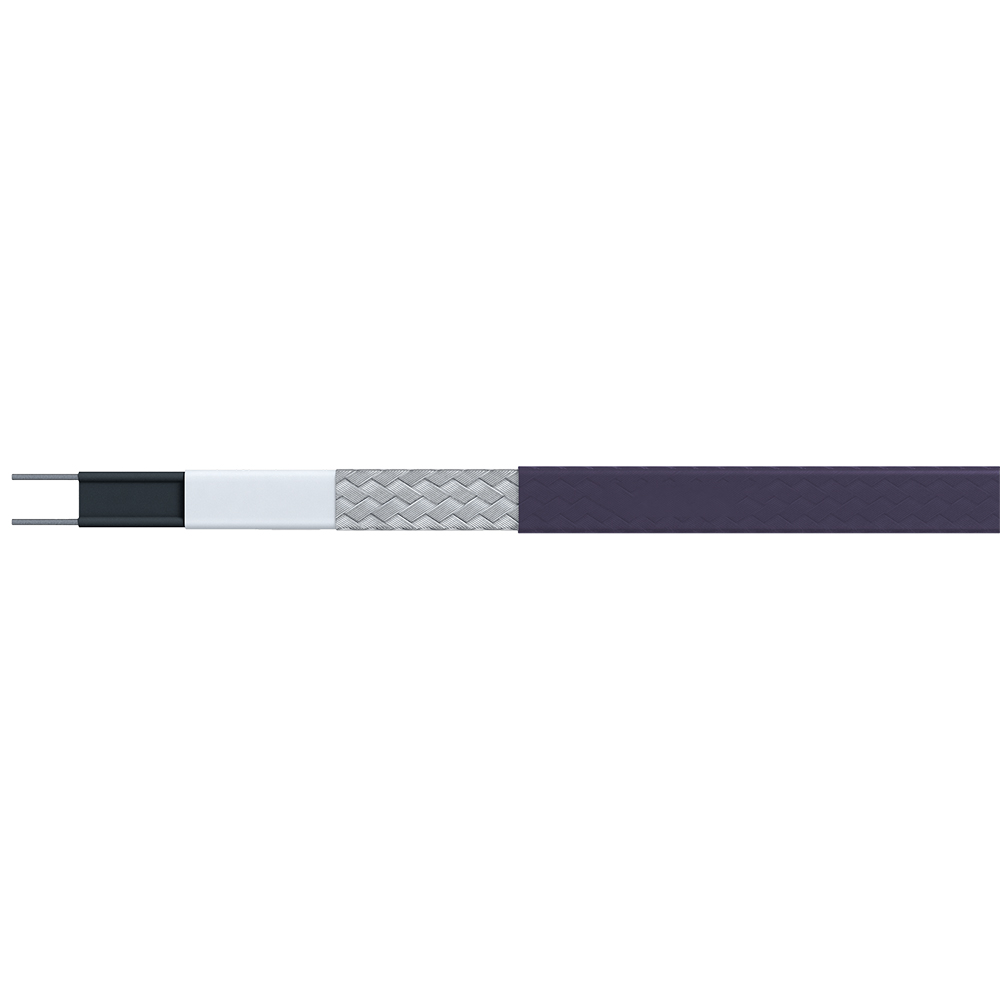
Self-regulating heat tracing is the most widely deployed technology today. Its polymer core automatically increases heat output in colder zones and reduces it in warmer sections, eliminating the risk of overheating even when cables overlap. This behaviour makes self-regulating cable particularly forgiving during installation and well-suited to complex pipework with valves, flanges, and irregular geometries.
Constant wattage parallel cables deliver the same heat output per metre regardless of local temperature. They are commonly used on longer circuit runs where uniform heating is required and the process temperature is controlled externally. Mineral-insulated cables, built from compacted magnesium oxide surrounded by a metal outer sheath, are reserved for demanding high-temperature environments such as steam lines, chemical reactors, and refinery pipework where polymer-based cables would degrade.
Key Applications Across Industries
Pipework trace heating is deployed wherever temperature loss poses a risk to process integrity, product quality, or infrastructure safety. The most significant application categories include:
- Oil and gas: Crude oil, heavy fuel oil, and condensate pipelines rely on trace heating to prevent viscosity increases that would impede pumping and increase energy demand. Offshore and Arctic pipeline segments are among the most demanding environments for trace heating systems.
- Chemical processing: Many chemical feedstocks and products have minimum temperature requirements for safe handling or processability. Trace-heated pipework maintains these temperatures through transfer, storage, and processing stages, preventing solidification, phase separation, or hazardous conditions.
- Water and utilities: Domestic and commercial water supply lines in cold climates are among the most common applications for self-regulating trace heating. A single burst pipe caused by freezing can release more than 1,000 litres of water per hour — making prevention the most cost-effective strategy.
- Food and beverage: Process pipework carrying edible oils, syrups, dairy products, and other temperature-sensitive materials requires trace heating to maintain product quality and comply with food safety standards.
- Pharmaceutical manufacturing: Strict temperature tolerances for active ingredients and solvents make trace-heated pipework a regulatory necessity in many pharmaceutical production environments.
Critical Factors in System Selection
Selecting the correct trace heating system for a given pipework application requires evaluating several interconnected variables. An undersized system will fail to maintain temperature during peak cold conditions; an oversized one wastes energy and may damage temperature-sensitive pipe materials.
The starting point is a heat loss calculation, which accounts for pipe diameter, pipe material, insulation thickness and thermal conductivity (lambda value), minimum design ambient temperature, and the required fluid maintain temperature. From this, the required watts per metre of cable output can be determined. As a practical reference, a DN50 (2-inch) water pipe with 50 mm of polyurethane foam insulation in a −15°C design environment typically requires 8–12 W/m of trace heating output for freeze protection.
Beyond the cable itself, the control system must match the application. Simple capillary thermostats are adequate for basic freeze protection of residential water lines. Industrial process maintenance applications benefit from electronic temperature controllers with alarm outputs, data logging, and remote monitoring — particularly where regulatory compliance or process continuity is critical. The design ambient temperature used in calculations should reflect the lowest recorded temperature at the site, not an average winter figure, to ensure the system performs under worst-case conditions.
Common Installation Mistakes to Avoid
The majority of trace heating system failures in the field are not caused by faulty equipment — they result from installation errors that compromise the cable's ability to transfer heat effectively. Referring to a thorough heat trace installation guide before starting work avoids the most costly errors. The most frequently encountered problems include:
- Omitting aluminium foil tape on plastic pipes. On metallic pipes, the heating cable contacts bare metal for direct heat transfer. On plastic pipe, that direct conduction path does not exist. Applying aluminium foil tape as a thermal spreader before attaching the cable distributes heat evenly and prevents localised hot spots — a step frequently skipped, with poor temperature uniformity as the result.
- Installing cable without insulation. Some contractors apply trace heating cable and leave the pipe uninsulated, assuming the cable alone will suffice. The result is a system consuming four to six times the energy necessary, with performance still inadequate in severe cold. Insulation is mandatory, not optional.
- Incorrect cable routing on horizontal runs. Cable routed at the top of a horizontal pipe is displaced by gravity over time, particularly if the pipe vibrates. Standard practice is to route cable at the 5 o'clock or 7 o'clock position — slightly below the pipe centreline — where it remains in stable contact.
- Failing to allow extra cable at fittings and valves. Valves, flanges, elbows, and pipe supports all represent significant additional heat loss compared to straight runs. Insufficient cable length at these points is a leading cause of freeze failures in otherwise well-designed systems.
Why Pipework Trace Heating Is a Smart Long-Term Investment
The upfront cost of a properly designed and installed pipework trace heating system is frequently compared unfavourably to doing nothing — until the alternative cost is counted. A single freeze event in an industrial facility can cause pipe bursts, production shutdowns, equipment damage, and environmental incidents that far exceed the total lifetime cost of the trace heating system that would have prevented them.
Modern self-regulating systems add an important operational advantage: because output automatically adjusts to ambient conditions, energy is consumed only where and when it is genuinely needed. A well-designed system with electronic control and quality insulation will consume a fraction of the energy that older constant-wattage systems required for the same level of protection.
Pipework trace heating is not a luxury addition to a facility — it is a fundamental element of reliable, safe, and energy-efficient plant operation in any environment where ambient temperatures threaten process integrity. As facilities age, as climate variability increases, and as operational standards tighten, the case for investing in correctly specified trace heating systems has never been stronger.

 English
 русский
 Français
 Español
 عربى
عربى
