What Is Self-Regulating Heat Tracing?
Self-regulating heat tracing is an electric heating technology designed to maintain the temperature of pipes, vessels, tanks, and industrial equipment by automatically adjusting its heat output in response to changing ambient and surface conditions. Unlike traditional constant wattage systems that deliver a fixed level of power regardless of need, a self-regulating heat trace cable responds intelligently to its thermal environment — producing more heat where and when it is cold, and reducing output where temperatures are already sufficient.
This capability makes self-regulating heat tracing the preferred solution for freeze protection, process temperature maintenance, viscosity control, and condensation prevention across a broad range of industrial and commercial settings. The technology has grown from a laboratory innovation into the dominant form of electric heat tracing used worldwide, with well over a billion feet of cable installed since its commercial introduction in the early 1970s.
How Self-Regulating Heat Trace Cable Works
The operating principle behind self-regulating heat trace cable is rooted in the behavior of a conductive polymer core — a material engineered to change its electrical resistance in direct response to temperature. Understanding this mechanism is essential for engineers selecting or specifying heat tracing systems.
The Conductive Polymer Core
At the heart of a self-regulating cable are two parallel copper bus wires embedded within a semi-conductive polymer matrix that has been loaded with carbon black particles. This matrix forms countless microscopic conductive pathways between the two bus wires. When the cable is cold, the polymer contracts, pressing the carbon particles close together and creating a dense network of electrical paths. Current flows freely through these paths, and the cable generates significant heat through resistive (I²R) heating.
As the cable and the surface it is tracing warm up, the polymer matrix expands. This expansion separates the carbon particles, disrupting many of the conductive pathways. The electrical resistance rises, current flow decreases, and heat output drops. When the surface cools again, the polymer contracts, the carbon network reconnects, and heat output increases once more. This process — governed by the Positive Temperature Coefficient (PTC) characteristic of the polymer — occurs independently at every point along the length of the cable, meaning each section of cable acts as its own thermostat.
Cross-Linking and Long-Term Reliability
A critical step in manufacturing high-quality self-regulating cable is radiation cross-linking of the polymer matrix. This process chemically bonds the polymer chains, ensuring that the material reliably contracts back to its original density each time it cools. Without cross-linking, the polymer could permanently deform over repeated heating and cooling cycles, degrading the cable's self-regulating performance. Cross-linking is what allows modern self-regulating cables to operate through tens of thousands of thermal cycles over a service life measured in decades.
Cable Construction Layers
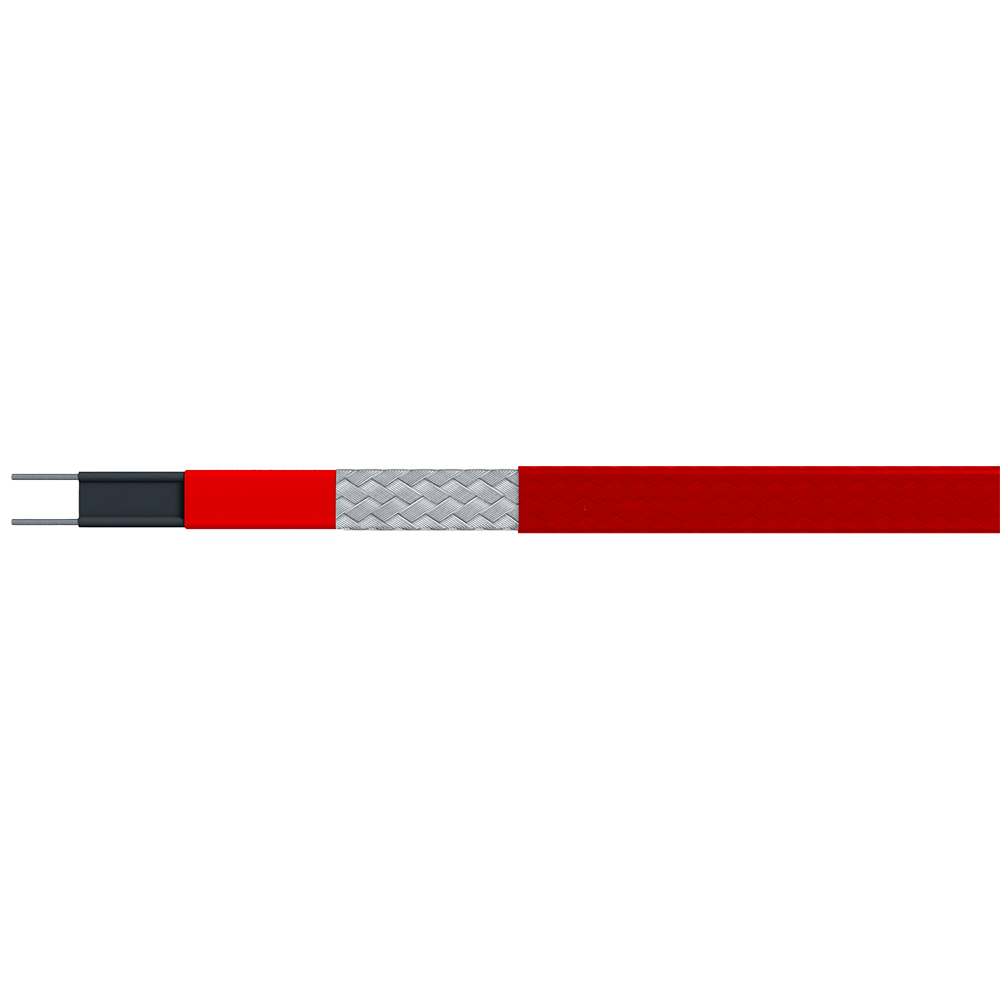
A typical self-regulating heat trace cable consists of the following layers from inside to outside:
- Two tinned copper bus wires — carry current along the circuit length
- Conductive polymer core — the self-regulating element that responds to temperature
- Polyolefin or fluoropolymer inner jacket — provides electrical insulation
- Metal braid (tinned copper or stainless steel) — provides mechanical protection and, where required, serves as a ground path or EMI shield
- Outer jacket — selected for chemical resistance, UV stability, or compliance with hazardous area requirements depending on the application
Because the circuit is parallel rather than series, the cable can be cut to any length in the field without altering its operating characteristics. This was a significant advancement over the factory-length constant wattage cables that preceded it.
Key Advantages Over Constant Wattage Systems
Self-regulating heat tracing offers several measurable advantages compared to constant wattage or series resistance heating cables, particularly in applications where ambient conditions vary or energy efficiency is a priority.
| Feature |
Self-Regulating Cable |
Constant Wattage Cable |
| Power output |
Varies with temperature |
Fixed regardless of conditions |
| Overheat risk |
Minimal — inherently self-limiting |
Present — requires thermostat control |
| Field cutting |
Cut to length on site |
Factory-specified lengths |
| Overlap installation |
Permitted |
Not permitted — burnout risk |
| Energy consumption |
Reduced in warm conditions |
Constant — no reduction |
| Circuit length flexibility |
High — parallel configuration |
Limited — series configuration |
Comparison of self-regulating and constant wattage heat trace cables across key performance parameters
The energy efficiency advantage is particularly significant in outdoor or uninsulated applications where ambient temperature swings are frequent. A self-regulating cable installed for freeze protection draws near-zero power on a mild day and ramps up automatically during a cold snap — with no controller intervention required. When combined with a temperature control system, energy consumption can be reduced even further by cycling the circuit off entirely during warmer periods.
Safety is another key advantage. Because the cable cannot sustain a runaway thermal condition on its own, the risk of ignition or pipe damage from localized overheating is substantially reduced. This characteristic is especially valued in applications involving temperature-sensitive materials or plastic piping systems.
Industrial and Commercial Applications
The adaptability of self-regulating heat trace cable has driven its adoption across a wide spectrum of industries and environments. The following represent the most significant application categories.
Freeze Protection for Process Piping
Preventing water, chemicals, or process fluids from freezing in exposed pipework is the most common application for self-regulating heat tracing. Refineries, chemical plants, water treatment facilities, and food processing operations rely on heat trace systems to maintain line temperatures above the freeze point of the process fluid during cold weather. Because pipe routing is rarely uniform and ambient temperatures along a run can vary significantly, the ability of the cable to respond independently at each point is directly operationally valuable.
Process Temperature Maintenance
Many industrial processes require fluids to be kept within a specific temperature range for flow, reaction, or quality control purposes. Viscous materials such as heavy fuel oils, waxes, resins, and adhesives solidify or become too thick to pump if allowed to cool. Self-regulating cables maintain the required process temperature along the full length of a pipe or vessel, ensuring consistent product quality and avoiding costly production interruptions. Temperature maintenance applications typically require cables rated for higher maintain temperatures, with some specialized products rated up to 210°C (410°F).
Roof, Gutter, and Drainage De-Icing
Commercial and residential buildings in cold climates use self-regulating heat trace cables to prevent ice dams from forming at roof edges and in gutters or downspouts. The self-regulating nature of the cable is particularly well suited here — the cable only draws significant power when temperatures are at or below freezing, making the system both effective and energy-conscious without requiring a dedicated controller.
Snow and Ice Melting for Surfaces
Self-regulating cables are embedded in concrete or asphalt at building entrances, loading docks, pedestrian walkways, bridge decks, and railway points to prevent dangerous ice and snow accumulation. These installations deliver consistent, maintenance-free performance over many years and can be activated automatically based on temperature and precipitation sensors.
Hazardous Area Applications
Many self-regulating cable products are certified for installation in potentially explosive atmospheres classified under IECEx, ATEX, or NEC standards. The inherently power-limiting character of the cable contributes to a favorable safety profile in these environments. Applications include oil and gas processing facilities, offshore platforms, petrochemical plants, and solvent handling operations.
Specialty Applications
Beyond conventional industrial and commercial uses, self-regulating heat trace is applied in:
- Soil warming to support early-season agricultural planting or protect root systems from frost
- Wastewater treatment infrastructure, including pump stations and sludge lines exposed to outdoor temperatures
- Cooling tower basins, where ice formation can damage infrastructure during winter shutdowns
- Tank and vessel heating for storage of temperature-sensitive liquids
- Perfume, flavor, and pharmaceutical manufacturing where precise viscosity control is required
Selection and Installation Considerations
Choosing the correct self-regulating heat trace cable for a given application involves evaluating several interconnected variables. An undersized or incorrectly specified cable can result in inadequate temperature maintenance, while an oversized selection may carry unnecessary cost without additional functional benefit.
Maintain Temperature and Exposure Temperature
Every self-regulating cable product has two critical temperature ratings: the maximum maintain temperature, which is the highest process or pipe temperature the cable is designed to hold, and the maximum intermittent exposure temperature, which is the highest temperature the cable can safely withstand during process upsets, steam cleaning, or equipment testing. These two values must both exceed the worst-case temperatures expected in the application. For typical freeze protection applications, cables with maintain temperatures of 65°C (150°F) are common. Viscosity control and process maintenance on high-temperature lines may require cables rated to 150°C (302°F) or above.
Power Output Requirements
The watts-per-meter (or watts-per-foot) output of the cable at a given ambient temperature must match or exceed the heat loss of the pipe or equipment being traced. Heat loss is calculated based on pipe diameter, insulation thickness and type, fluid maintain temperature, and the minimum expected ambient temperature. Inadequately powered cables will fail to maintain the required temperature during the coldest design conditions. Standard output ratings for self-regulating cables range from approximately 10 W/m to 40 W/m or more depending on the cable grade and ambient temperature.
Inrush Current and Circuit Protection
One characteristic of self-regulating cables that requires attention during system design is the high inrush current drawn when the cable is first energized at cold temperatures. When the polymer core is fully contracted and at its most conductive state, initial current draw can be several times the steady-state operating value. Circuit breakers must be sized appropriately — typically using time-delay or slow-blow devices — to avoid nuisance tripping during startup. This inrush behavior is distinct from constant wattage cables and must be accounted for in the electrical design of the distribution system.
Jacket Material Selection
The outer jacket of the cable must be chemically compatible with any substances it may contact in service, including the pipe insulation material, chemical splashes, cleaning agents, or immersion fluids. Polyolefin jackets are suitable for general industrial use. Fluoropolymer (such as PVDF or PTFE-based) jackets are selected for applications involving aggressive chemicals, high temperatures, or environments requiring low smoke and halogen-free properties. In immersion applications — such as placement inside a pipe or in a fluid tank — the jacket must also be rated for continuous fluid contact.
Installation Best Practices
Self-regulating cables are straightforward to install compared to series resistance systems, but attention to detail during installation directly affects long-term performance. Key practices include:
- Securing the cable to the pipe at regular intervals using manufacturer-recommended attachment tape or clips, ensuring consistent thermal contact
- Adding extra cable around valves, flanges, and supports, which act as heat sinks and require additional heat input to maintain temperature
- Using appropriate end-seal, splice, and junction kits rated for the installation environment and voltage
- Completing an installation test using insulation resistance measurement before energizing the circuit
- Applying thermal insulation over the traced pipe to improve system efficiency and reduce the power required to meet the maintain temperature target
The Future of Self-Regulating Heat Tracing
Since its invention in 1972, self-regulating heat tracing has steadily displaced older heating technologies across virtually every industrial sector. Ongoing developments in polymer science, materials engineering, and digital monitoring are continuing to expand the capability and efficiency of these systems. Smart heat tracing systems now integrate self-regulating cables with networked temperature controllers and remote monitoring platforms, enabling real-time performance verification, predictive maintenance alerts, and energy reporting across large installed bases.
As industrial operations face growing pressure to reduce energy consumption and minimize maintenance costs, the combination of inherent self-regulation and evolving control intelligence positions self-regulating heat tracing as a foundational technology for reliable, low-maintenance temperature management in demanding environments. Whether the application is a small freeze protection circuit on a water service line or a large-scale viscosity control system in a refinery, self-regulating heat trace cable continues to deliver the performance, flexibility, and safety that engineers and plant operators depend on.

 English
 русский
 Français
 Español
 عربى
عربى
